Roundup
Best curtain rods for bay windows
A bay is three windows and two corners. The corners are the whole problem.
By Janet H. · Last updated September 23, 2026 · How we choose
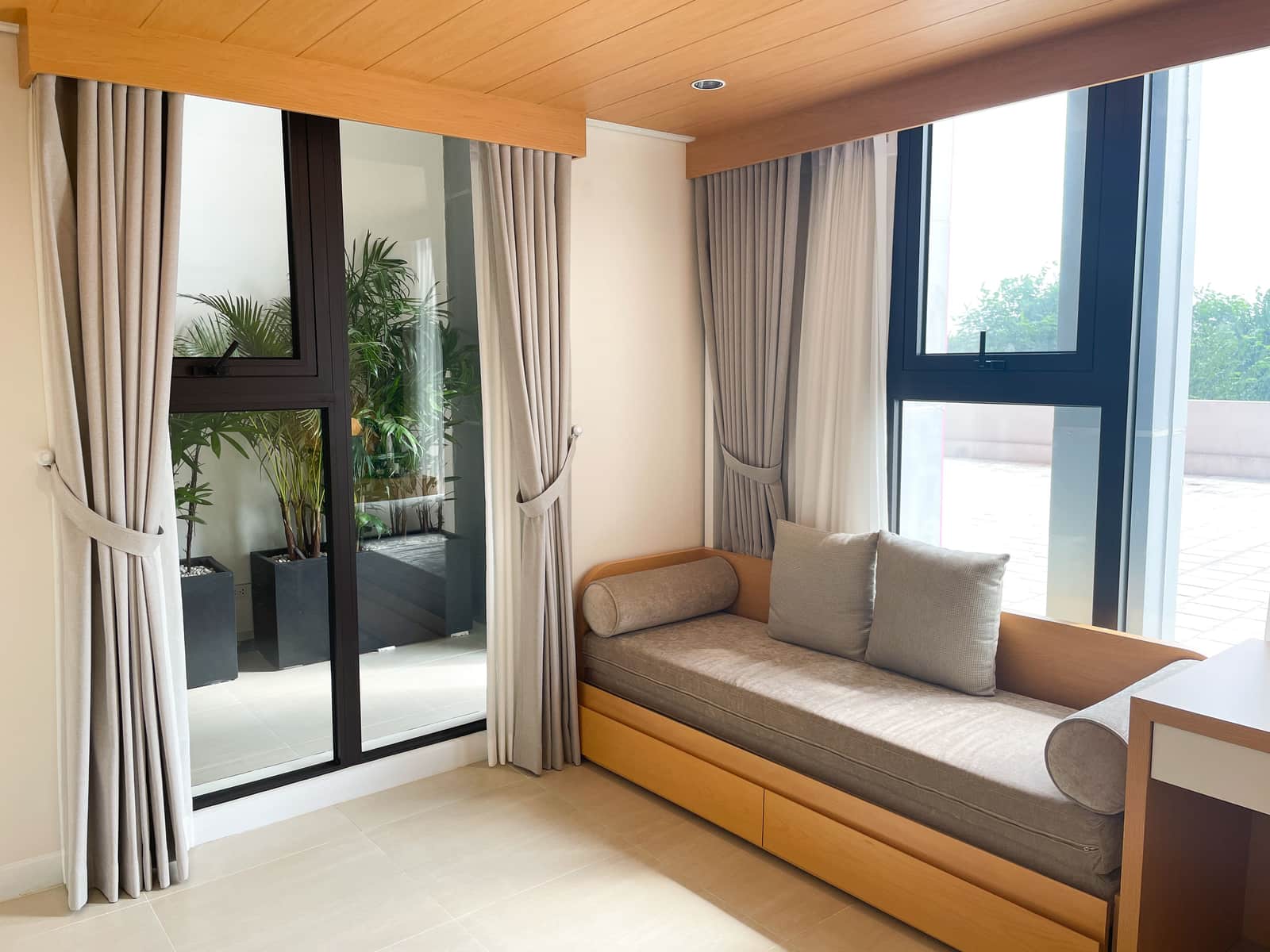
A bay window is three windows meeting at two corners, and the corners are where every attempt goes wrong. A straight rod across the front of the bay wastes the recess and looks like a curtain hung in front of a hole. Three separate rods leave the corners uncovered and light streaming through them. What you need is one continuous run that turns each corner — which means either corner connectors or a purpose-built bay set.
Before you buy either, measure the angles. Bays are commonly 135 degrees at each corner but they are not standardized, and a connector that only does 90 degrees will not fit a shallow bay.
Drape & Dawn earns a commission from qualifying purchases made through links on this page, at no extra cost to you. It does not change what we recommend. Full disclosure.
Before the list
Connectors or a complete set
Corner connectors are hinged joints that clamp two lengths of rod together at an adjustable angle, typically anywhere between 90 and 180 degrees. You buy the rods separately, cut or extend them to each section's length, and join them. Flexible, cheap, and it means you can use whatever rod you already like.
Complete bay sets ship as three telescoping rods, two elbow connectors and all the brackets, sized for a typical bay. Simpler and tidier, and only if your bay is close to the geometry the set assumes.
Either way you need a bracket on each side of every corner, close to the joint. A connector is a hinge, not a structural member, and an unsupported corner will droop.
| # | Best for | Product | Type | Angle range | Fits rod | Price |
|---|---|---|---|---|---|---|
| 1 | Best overall | Window corner curtain rod connectors, adjustable Any bay whose angles are not standard, and anyone who wants to choose the rod rather than accept whatever a bay set includes. | Connectors only | ~90–180 degrees | 1 in diameter | Check price on Amazon #ad We don’t show prices — check the current one on Amazon. How we’re funded |
| 2 | Best complete set | 1-inch diameter bay window curtain rod set Standard bays where you would rather buy one thing than assemble a system. | Complete bay set | Standard bay angles | 1 in, supplied | Check price on Amazon #ad We don’t show prices — check the current one on Amazon. How we’re funded |
| 3 | Best for a four-sided bay | Dipper 4-sided bay window curtain rod Square bays and bow windows with four straight sections rather than three. | Complete bay set | Four-sided configuration | 13/16 in, supplied | Check price on Amazon #ad We don’t show prices — check the current one on Amazon. How we’re funded |
| 4 | Best alternative to a bay rod | Cordless Fabric Roman Shades, one per section Bays with awkward angles, shallow corner walls, or where a continuous rod would look heavy in the space. | Per-section shades | N/A | N/A | Check price on Amazon #ad We don’t show prices — check the current one on Amazon. How we’re funded |
01 — Best overall
Window corner curtain rod connectors, adjustable
Corner connector sets
Hinged connectors that clamp two 1-inch rods together at an angle you set, typically adjustable between 90 and 180 degrees, sold in pairs with fixing screws. Buy rods to suit each section and join them.
Who it’s for: Any bay whose angles are not standard, and anyone who wants to choose the rod rather than accept whatever a bay set includes.
The catch: You are assembling a system rather than buying one, so you need to get each section's rod length right yourself. Panels cannot slide past a connector.
At a glance
- Type
- Connectors only
- Angle range
- ~90–180 degrees
- Fits rod
- 1 in diameter
- Includes
- Two connectors, screws
- Brackets
- Buy separately, one each side of a corner
#ad We don’t show prices — check the current one on Amazon. How we’re funded
02 — Best complete set
1-inch diameter bay window curtain rod set
Meriville
A purpose-made bay set: telescoping rods for each section, elbow connectors and brackets, in a single package sized for a conventional three-sided bay.
Who it’s for: Standard bays where you would rather buy one thing than assemble a system.
The catch: Sized around typical bay geometry. An unusually deep, shallow or wide bay may fall outside what the telescoping ranges cover.
At a glance
- Type
- Complete bay set
- Angle range
- Standard bay angles
- Fits rod
- 1 in, supplied
- Includes
- Rods, elbows, brackets
- Brackets
- Included
#ad We don’t show prices — check the current one on Amazon. How we’re funded
03 — Best for a four-sided bay
Dipper 4-sided bay window curtain rod
Rod Décor
A bay rod system configured for a four-sided bay — the bow or square bay that a standard three-section set cannot cover.
Who it’s for: Square bays and bow windows with four straight sections rather than three.
The catch: Specific geometry. If your bay is a conventional three-sided one, a standard set or connectors will be simpler and cheaper.
At a glance
- Type
- Complete bay set
- Angle range
- Four-sided configuration
- Fits rod
- 13/16 in, supplied
- Includes
- Rods, connectors, brackets
- Brackets
- Included
#ad We don’t show prices — check the current one on Amazon. How we’re funded
04 — Best alternative to a bay rod
Cordless Fabric Roman Shades, one per section
Arlo Blinds
Instead of solving the corner, avoid it: fit a separate shade inside each section of the bay. Light control is neater per window, the corners stop being a problem, and it usually costs less than a custom bay rod.
Who it’s for: Bays with awkward angles, shallow corner walls, or where a continuous rod would look heavy in the space.
The catch: You lose the continuous sweep of fabric that makes a bay look furnished. Many people add a single decorative curtain across the front of the bay to get it back.
At a glance
- Type
- Per-section shades
- Angle range
- N/A
- Fits rod
- N/A
- Includes
- Shade and brackets per window
- Brackets
- Inside each section
#ad We don’t show prices — check the current one on Amazon. How we’re funded
Buying guide
Measuring a bay
- 1
Measure each section separately
Measure the width of each of the three (or more) sections along the wall, not across the opening. Add 4 to 6 inches at each outer end for the stack, as with any window.
- 2
Measure the corner angles
Hold a piece of card into each corner and mark the angle, or use a phone protractor app. Check the connector's stated range covers it — most adjust 90 to 180 degrees, which covers almost all domestic bays.
- 3
Check the wall depth at the corners
Corners often have less flat wall than you expect, particularly where a window frame comes close to the angle. The bracket needs somewhere solid to sit within a few inches of the joint.
- 4
Decide how the panels will move
Most bays work best with a fixed panel at each outer end and one or two that draw. Panels cannot travel round a corner connector, so plan the stack positions before you buy.
The alternative: separate shades per section
If the corners defeat you, fit a separate shade inside each section of the bay and skip the continuous rod entirely. It gives you neater light control per window, costs less than a custom bay rod, and the bay's own frame provides the visual continuity. Many bays end up with shades in the sections and a single decorative curtain across the front of the whole bay.
Methodology
How we chose
Selection is on angle adjustability, rod diameter compatibility, and whether a product ships complete or as components. We have not fitted these in a bay and make no claim about a specific bay geometry. Methodology.
FAQ
Questions people actually ask
What kind of curtain rod do I need for a bay window?
One continuous run that turns each corner — either separate rods joined with adjustable corner connectors, or a purpose-built bay set with elbows included. A straight rod across the front of the bay wastes the recess.
What angle are bay window corners?
Commonly around 135 degrees on a three-sided bay, but it is not standardized. Measure yours with a card or a protractor app and check the connector's adjustment range covers it before ordering.
Can curtains slide around a bay corner?
Not past a rigid connector. Plan for a fixed panel at each outer end and one or two that draw within a straight section. A flexible track is the only way to get a panel round a corner.
Do I need extra brackets at the corners?
Yes — one on each side of every corner, close to the joint. A connector is a hinge, not a structural member, and unsupported corners droop under the weight of the panels.
Is it easier to use shades in a bay?
Often, yes. A separate shade in each section avoids the corner problem completely, gives neater light control per window, and usually costs less than a custom bay rod. Many bays end up with both.
Keep going
Read next
Rods & Mounting
Best curtain rods
The part everyone underspends on — what each rod carries and when to add a support.
Rods & Mounting
How to measure for curtains
Four steps in order: rod width, fullness, drop from the rod, header.
Compare
Best roman shades
Fabric softness with a shade's precision — plus the stack depth nobody mentions.
Rods & Mounting
Inside mount vs outside mount
Tidy and leaky, or bigger and light-tight — and how the choice changes your measuring.
Rooms
Window treatments for a living room
Glare, evening privacy and a big opening — handled with two light layers, not one heavy one.
About the author
Janet H.
Janet H. is the owner of Janet Media Group and the person behind Drape & Dawn. She researches every pick against the site's published methodology.
Published by Janet Media Group · Last updated September 23, 2026