Comparison
Blackout curtains vs window film
One of these is the better product and the other is the better answer, and which is which depends entirely on whether you ever want the window back.
By Janet H. · Last updated November 5, 2026 · How we choose
Blackout window film is better at blocking light than any curtain, and for most people it is still the wrong choice. Film goes onto the glass, so there is no edge for daylight to come around and nothing to leak - but the window is then dark all the time, with no view and no daylight, until you peel it off. A blackout curtain blocks less light and gives you the window back in one movement.
That is the whole comparison in two sentences, and the rest of this page is about the cases where the obvious answer is wrong: the day sleeper, the home theater, the garage window, the rental you cannot drill, and the very common situation where the honest answer is both at once.
Drape & Dawn earns a commission from qualifying purchases made through links on this page, at no extra cost to you. It does not change what we recommend. Full disclosure.
The decision table
Side by side
| Blackout curtain | Blackout window film | |
|---|---|---|
| Where it sits | In front of the window, on a rod | On the glass itself |
| Light through the covered area | Effectively none through the fabric | None |
| Light around the edges | The usual failure - top, sides and floor | None through the glass it covers |
| Daylight on demand | Yes, open it | No, not while it is on |
| View | Back in a second | Gone until the film comes off |
| Privacy at night | While closed | Always |
| Reversible | Entirely | Peels off, but it is a job |
| Needs drilling | Usually a rod and brackets | No |
| Cost bracket | Tens of dollars per window | Single-digit to low tens per window |
| Insulation | Some, from the trapped air layer | Negligible |
| Looks like | A furnished window | A blanked-out window |
Mechanism
Why a blackout curtain leaks and film does not
A blackout curtain's fabric does its job almost perfectly. Hold a good panel up to a lamp and nothing comes through it. The light in your bedroom at six in the morning is not coming through the fabric - it is coming around it: over the top of a grommet header, down the half-inch gap between the panel edge and the wall, and under the hem. That is a geometry problem, not a fabric problem, and it is why two people can buy the same curtain and get completely different results. How to fix curtain light gaps is the page that works through each gap in turn.
Film has no geometry problem because there is no gap to have. It is bonded to the pane by static cling or adhesive, so the covered glass transmits nothing at all. The only light that can still get in is around the sash itself - through a gap in an old frame, or past the edge of the film if it is cut short of the glazing bead. Cut it properly and the window is simply not a light source any more.
The honest case against film
What film costs you that the table understates
You lose the window. Not for the night - for as long as the film is on. The room has no view, no daylight, and no sense of time, and a bedroom treated this way is a notably strange place to be at two in the afternoon. People who install blackout film in an ordinary bedroom very often take it off again within a season, which makes it an expensive way to buy a curtain.
There are two practical cautions as well. First, a dark film absorbs solar energy at the glass, which makes the pane run hotter than it was designed to; film makers and window manufacturers both publish guidance on this, and some sealed double-pane warranties exclude applied films. Check the film listing and your window warranty before covering a modern insulated unit. Second, removal is easy in principle and tedious in practice, particularly on an adhesive film that has had a hot summer to cure - static cling versions are much kinder here, which is why the pick below is one.
The honest case for the curtain
What a curtain gives you that film cannot
A window you can still use. That is the whole of it, and it is worth more than the comparison table makes it look. Beyond that: a lined panel traps a layer of still air in front of the glass, which does a little for a cold window and is the mechanism behind every thermal curtain claim - do thermal curtains save energy sets out what can and cannot be claimed there. Fabric also softens the sound inside a room, though it does not block noise from outside, which do blackout curtains block sound explains properly. And a curtain is the only one of the two that makes the room look finished.
The curtain's weakness is entirely fixable, which is the part most people miss. Mount the rod high and at least eight inches wider than the opening on each side, use a wrap-around rod so the panel edge meets the wall, and run the panel to the floor. Done properly, a blackout curtain gets a bedroom genuinely dark. Done badly, it produces a bright halo around a very expensive piece of fabric.
Deciding
Choose film if…
- You sleep during the day and the room's daylight is worth nothing to you.
- It is a home theater, a studio, a garage or a utility window where the view is not a loss.
- You rent and cannot drill, and a tension rod will not carry a blackout panel across the opening.
- The window is an awkward shape - a porthole, a transom, a half-round - that no curtain will cover neatly.
- You want privacy around the clock without thinking about whether the curtain is shut.
- The budget is a few dollars per window and it has to work tonight.
Deciding
Choose a blackout curtain if…
- It is a bedroom you also use in the daytime.
- You want the room to look furnished rather than boarded up.
- The window is on a modern sealed double-pane unit whose warranty you would rather not test.
- You want a little thermal benefit alongside the darkness.
- You expect to move, or to change your mind.
- The light problem is seasonal - the early-summer sunrise rather than the whole year.
The combination
The case for both
For a shift worker, the strongest setup is not either one: it is film on the glass with a curtain in front of it. The film removes the glass as a light source completely, which is the part a curtain cannot do, and the curtain covers the frame edges, softens the room and stops it looking like a blanked-out window from inside. It is also the cheapest genuinely dark bedroom available, because the film does the hard work and the curtain no longer has to be a high-performance one.
If that is your situation, blackout curtains for night shift workers goes through the full setup, and how to block light from windows catalogs the other layers - liners, side channels, pelmets - in the order they are worth adding.
Claims
A note on the numbers in both categories
Both sides of this comparison are sold with percentages. Curtains quote fabric light-transmission figures measured on a sample, which say nothing about the gaps that actually ruin a dark room. Films quote 100 percent light blocking, which is true of the glass they cover and silent about the frame. Neither number is dishonest and neither predicts your room. We publish no light-blocking figure of our own for exactly that reason, and the only test that matters is standing in the room at the hour you care about.
Methodology
How we chose
This comparison is built from the published mechanism of each approach, manufacturers' own descriptions and application guidance, and the failure patterns owners report - blackout curtains underperforming because of how they were mounted, and blackout film being removed again because the room became unusable in daylight. We do not lab-test fabric or film, and we publish no light-transmission figure of our own. Cost brackets are deliberately qualitative. Full criteria on the methodology page.
What we’d buy
The products behind this advice
Picked against the criteria above, not the other way round. Prices are read from Amazon and refreshed daily; each link goes to the current listing.
| # | Best for | Product | Type | Care | Price |
|---|---|---|---|---|---|
| 1 | If you chose the curtain | 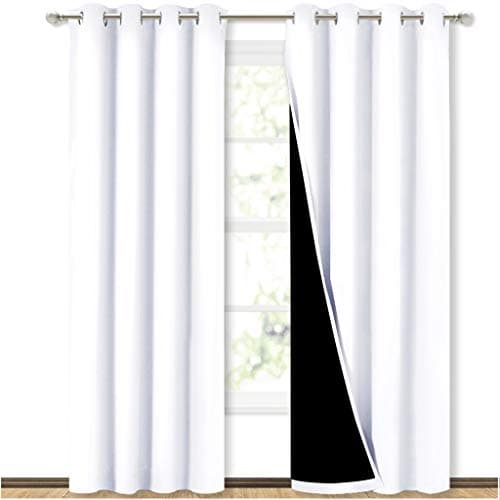 A bedroom you still want to use as a room - daylight on demand, a view when you want one, and the window back to normal in a second. | Blackout curtain | Machine wash cold | $19.99 · View on Amazon #ad Price as of November 5, 2026, and it can change. How we’re funded |
| 2 | If you chose the film | 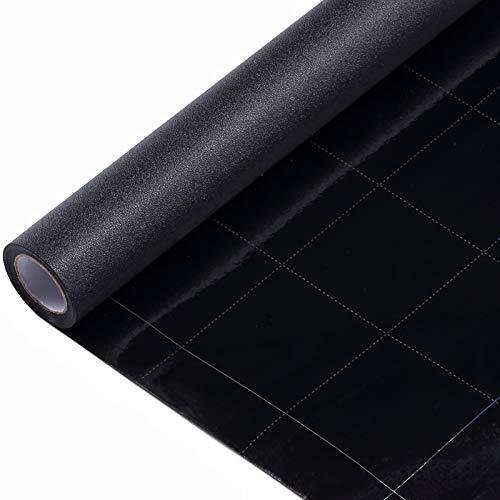 A day sleeper's bedroom, a home theater or a garage window where nothing is lost by giving the window up entirely. | Blackout window film | Wipe clean, repositionable | $30.99 · View on Amazon #ad Price as of November 5, 2026, and it can change. How we’re funded |
| 3 | If the curtain is up and light still gets in | 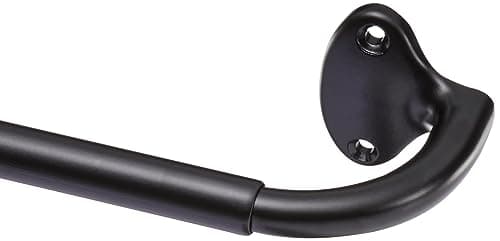 Anyone whose blackout panels are already hung and leaking at the sides - the gap is the problem, not the fabric. | Curtain rod | — | $29.97 · View on Amazon #ad Price as of November 5, 2026, and it can change. How we’re funded |
01 — If you chose the curtain
Thermal Insulated Blackout Curtains
NICETOWN
Triple-weave polyester with no coating to crack or peel, machine washable, and sold in a wider ladder of drops than most ranges — including the 108-inch length a near-ceiling rod needs.
Who it’s for: A bedroom you still want to use as a room - daylight on demand, a view when you want one, and the window back to normal in a second.
The catch: The grommet header holds the panel an inch off the wall with open gaps between grommets, so light still comes over the top. Add a pelmet, or choose a back-tab version, if that is your problem.
At a glance
- Type
- Blackout curtain
- Construction
- Triple-weave, uncoated
- Care
- Machine wash cold
- Drops
- 63 / 84 / 96 / 108 in
#ad Price as of November 5, 2026, and it can change. How we’re funded
02 — If you chose the film
Static Cling Total Blackout Window Film, 35.4 x 78.7 in
VELIMAX
An opaque black vinyl applied to the glass itself with water and no adhesive. Because it sits on the pane rather than in front of it, there is no edge for light to come around - the glass simply stops transmitting, day and night.
Who it’s for: A day sleeper's bedroom, a home theater or a garage window where nothing is lost by giving the window up entirely.
The catch: It takes the window away for as long as it is on: no view, no daylight, and no changing your mind in the afternoon. A dark film also runs hotter against the glass than clear film does, so check the listing and your window's warranty before applying it to a sealed double-pane unit.
At a glance
- Type
- Blackout window film
- Attachment
- Static cling, no adhesive
- Sheet
- 35.4 x 78.7 in
- Care
- Wipe clean, repositionable
#ad Price as of November 5, 2026, and it can change. How we’re funded
03 — If the curtain is up and light still gets in
Room Darkening Blackout Curtain Rod, wrap-around
Amazon Basics
A curved rod whose ends bend back to the wall, so the curtain edge meets the wall instead of ending in open air. That built-in return closes the biggest light path on a blackout setup without separate return brackets.
Who it’s for: Anyone whose blackout panels are already hung and leaking at the sides - the gap is the problem, not the fabric.
The catch: The curve keeps the stack slightly over the glass when the panels are open, costing a little daylight.
At a glance
- Type
- Curtain rod
- Feature
- Built-in returns
- Spans
- 28–48 and 48–88 in
- Supports
- Center bracket on wide sizes
#ad Price as of November 5, 2026, and it can change. How we’re funded
FAQ
Questions people actually ask
Is blackout window film better than blackout curtains?
At blocking light, yes - film sits on the glass so there is no edge for daylight to come around, while a curtain always leaks at the top, sides and hem. At being a window covering, no: the film leaves the room with no daylight and no view until you peel it off. Film wins for a day sleeper, a home theater or a garage; a curtain wins for a bedroom you also use in the daytime.
Can you use blackout film and curtains together?
Yes, and for a shift worker it is the best setup there is. The film removes the glass as a light source entirely, the curtain covers the frame edges and makes the room look furnished, and because the film is doing the hard work the curtain does not have to be a high-performance one.
Does blackout window film damage windows?
A dark film absorbs solar energy and makes the pane run hotter than it was designed to, and some sealed double-pane window warranties exclude applied films for that reason. Check the film listing and your own window warranty before applying it to a modern insulated unit. Static cling films are also far easier to remove later than adhesive ones.
Why do my blackout curtains still let light in?
Almost always because of the gaps rather than the fabric. Light comes over the top of a grommet header, down the space between the panel edge and the wall, and under the hem. Mount the rod high and wide, use a rod with wrap-around returns so the edge meets the wall, and run the panel to the floor.
Is blackout film the same as privacy film?
No. Privacy film - frosted or mirrored - obscures the view while still letting daylight through, and mirrored versions stop working at night. Blackout film is opaque, blocks the light completely, and is private day and night. Buying frosted film expecting darkness is a common and disappointing mistake.
Can renters use blackout window film?
Static cling film is one of the better renter options: it needs no adhesive, no drilling and no fixings, it goes on with water, and it peels off cleanly at the end of a tenancy. Check your lease for anything about altering windows, and keep the backing sheet so you can store the film flat if you want to reuse it.
Sources
What we referenced
Keep going
Read next
Blackout
Best blackout curtains for a room that's too bright
Panels that block light, plus the mounting rule that decides whether any of them works.
Blackout
How to fix curtain light gaps
Close the side, top, middle and bottom gaps — the cheapest fix for a bright room.
Blackout
How to block light from windows
Every method for blocking window light, ranked by darkness achieved and effort required.
Blackout
Blackout curtains for night shift workers
Sleeping at noon in full sun is a different problem from sleeping through dawn.
Privacy
Best window privacy film
Renter-safe privacy with no hardware — and why mirrored film is the one to avoid.
Drafts
Insulated curtains vs window film
Film performs better and looks worse. Curtains, the reverse. Here's how to choose.
About the author
Janet H.
Janet H. is the owner of Janet Media Group and the person behind Drape & Dawn. She researches every pick against the site's published methodology.
Published by Janet Media Group · Last updated November 5, 2026