Guide
Do blackout curtains actually work?
Short answer: the fabric does. The installation usually doesn't — and that's where nearly every disappointment comes from.
By Janet H. · Last updated September 23, 2026 · How we choose
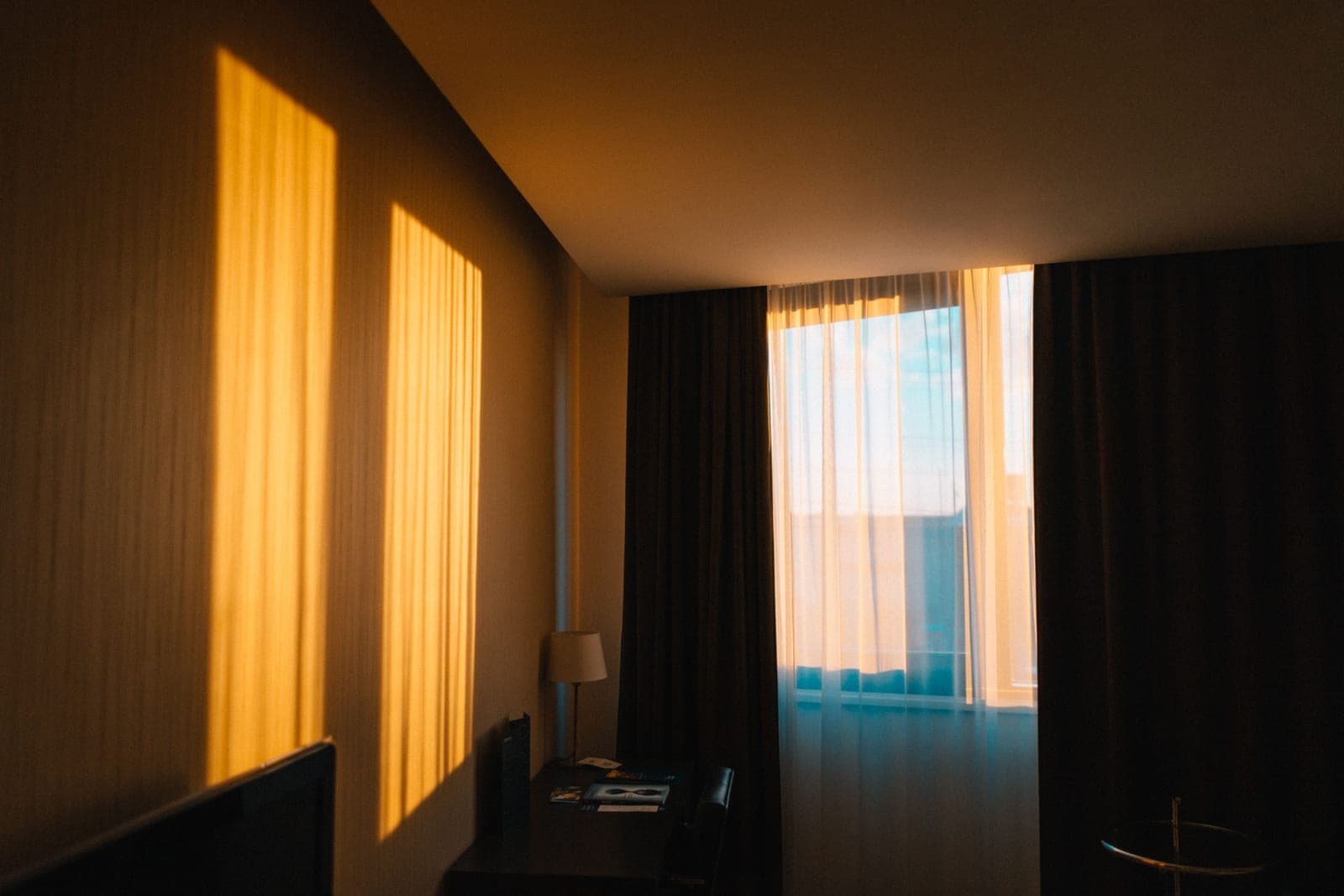
Yes — the fabric works. The installation usually doesn't. A blackout panel stops essentially all light passing through it, but light still travels *around* it: over the header, down the sides, through the gathers and under the hem. In a typical badly-mounted setup, the great majority of the light entering the room never touches the fabric at all.
That is why the answer to "do they work" depends almost entirely on how they are hung, and why the most useful thing you can do before buying a second set is work out where your light is actually coming from.
Drape & Dawn earns a commission from qualifying purchases made through links on this page, at no extra cost to you. It does not change what we recommend. Full disclosure.
Diagnosis
Find out where your light is getting in
Close the curtains during the day, stand in the room, let your eyes adjust for a minute, and look at the window. You will see the light path clearly, and it will be one or more of five places.
| Where you see light | What's causing it | The fix |
|---|---|---|
| A bright line down each side | Rod is too narrow, or panels too narrow | Wider rod: window width plus 8–12 in |
| A glow over the top | Grommet gap, or rod too close to the frame | Mount higher, add a pelmet, or use back-tab panels |
| Light at the floor | Panels too short | Floor-length panels, measured from the rod |
| Light through the middle | Panels don't overlap where they meet | More total panel width, or an overlapping track |
| A soft glow across the fabric | Genuinely room darkening, not blackout | This one is the fabric — see blackout vs room darkening |
Only that last row is a fabric problem. The other four are mounting problems and they are all cheaper to fix than a new set of curtains.
The mechanism
Why the edges matter so much
Two things make the edge gaps worse than they sound. The first is how the eye works: a dark-adapted eye is extraordinarily sensitive, so a slit of daylight that would be invisible in a lit room reads as bright at 5am. The second is bounce — light entering through a side gap hits a pale wall or ceiling and scatters across the whole room. A gap does not just light the strip beside it; it lights everything.
That is also why a return — a bracket that bends back so the panel meets the wall at each end — makes such a disproportionate difference. It closes the gap between the panel and the wall, which is the path that produces the most bounce. Returns cost very little and they are the single highest-value upgrade to a set of curtains you already own.
Honest accounting
What blackout curtains genuinely do
- Block light through the fabric. Essentially completely, in a true blackout weave. This part is not in dispute.
- Slow heat loss. A closed lined panel adds a still-air layer against cold glass. Real, though smaller than the marketing implies — see do thermal curtains save energy.
- Reduce echo and high-frequency noise. Heavy fabric absorbs some sound inside the room. It is not soundproofing.
- Protect furnishings from UV. A closed panel during peak sun measurably slows fading on floors and upholstery.
Honest accounting
What they don't do
- Block traffic noise. Low-frequency sound needs mass and an airtight seal. A curtain hanging loose in front of glass provides neither.
- Keep a room cool on their own. Dark blackout fabric absorbs solar heat and re-radiates part of it inward. Light or silver-backed panels do better.
- Fix a light gap at the top. No fabric choice addresses light coming over the header. That needs a pelmet, a higher mount, or a ceiling track.
- Work on their own in a rental recess. An inside-mounted panel cannot overlap the frame, so the side gaps are structural. Layer it — see window treatments for renters.
If the diagnosis comes back as coverage, the fixes are laid out step by step in how to fix curtain light gaps. If it really is the fabric, the panels that block light properly are in best blackout curtains.
What we’d buy
The products behind this advice
Picked against the criteria above, not the other way round. We don’t show prices because we don’t have a live price feed — each link goes to the current listing.
| # | Best for | Product | Type | Care | Price |
|---|---|---|---|---|---|
| 1 | Fix the mounting first | Room Darkening Blackout Curtain Rod, wrap-around Anyone whose diagnosis came back as edge light rather than fabric — which is most people. | Curtain rod | — | Check price on Amazon #ad We don’t show prices — check the current one on Amazon. How we’re funded |
| 2 | If the fabric really is the problem | Thermal Insulated Blackout Curtains Rooms where the lamp test showed light passing through the panel itself. | Blackout curtain | Machine wash cold | Check price on Amazon #ad We don’t show prices — check the current one on Amazon. How we’re funded |
01 — Fix the mounting first
Room Darkening Blackout Curtain Rod, wrap-around
Amazon Basics
A curved rod whose ends bend back to the wall, so the curtain edge meets the wall instead of ending in open air. That built-in return closes the biggest light path on a blackout setup without separate return brackets.
Who it’s for: Anyone whose diagnosis came back as edge light rather than fabric — which is most people.
The catch: The curve keeps the stack slightly over the glass when the panels are open, costing a little daylight.
At a glance
- Type
- Curtain rod
- Feature
- Built-in returns
- Spans
- 28–48 and 48–88 in
- Supports
- Center bracket on wide sizes
#ad We don’t show prices — check the current one on Amazon. How we’re funded
02 — If the fabric really is the problem
Thermal Insulated Blackout Curtains
NICETOWN
Triple-weave polyester with no coating to crack or peel, machine washable, and sold in a wider ladder of drops than most ranges — including the 108-inch length a near-ceiling rod needs.
Who it’s for: Rooms where the lamp test showed light passing through the panel itself.
The catch: The grommet header holds the panel an inch off the wall with open gaps between grommets, so light still comes over the top. Add a pelmet, or choose a back-tab version, if that is your problem.
At a glance
- Type
- Blackout curtain
- Construction
- Triple-weave, uncoated
- Care
- Machine wash cold
- Drops
- 63 / 84 / 96 / 108 in
#ad We don’t show prices — check the current one on Amazon. How we’re funded
FAQ
Questions people actually ask
Why is my room still bright with blackout curtains?
Almost certainly light coming around the panels rather than through them. Look at the window with the curtains closed during the day: a bright line down the sides means the rod is too narrow, a glow over the top means it is mounted too low or too close to the wall.
Do blackout curtains help you sleep?
Darkness supports the body's sleep signaling, and removing an early-morning light source is one of the few environmental changes that reliably reduces early waking. The curtain only helps to the extent the room actually gets dark, which comes back to installation.
Do blackout curtains block 100% of light?
The fabric can come very close. The installation almost never does, because light travels around the panel. Treat any '100% blackout' claim as being about the fabric in isolation, not about the room you will end up with.
Will blackout curtains make my room cooler?
A little, and less than you would hope with a dark panel — dark fabric absorbs solar heat and re-radiates some of it into the room. A light-colored or silver-backed panel does better, and stopping the sun outside the glass does better still.
Are expensive blackout curtains worth it?
Past a fairly low threshold, no. A mid-priced triple-weave panel blocks light as well as a much more expensive one. Spend the difference on a wider rod, a center support bracket and returns — that buys you far more darkness per dollar.
Keep going
Read next
Blackout
How to fix curtain light gaps
Close the side, top, middle and bottom gaps — the cheapest fix for a bright room.
Blackout
Best blackout curtains for a room that's too bright
Panels that block light, plus the mounting rule that decides whether any of them works.
Blackout
Blackout vs room darkening
Neither label is regulated — here's the real difference and which room wants which.
Rods & Mounting
What size curtain rod do I need?
Window plus 8 to 12 inches — with the full size table and support rules.
Rooms
Window treatments for a bedroom
Darkness, warmth and privacy from one window — in the right order.
About the author
Janet H.
Janet H. is the owner of Janet Media Group and the person behind Drape & Dawn. She researches every pick against the site's published methodology.
Published by Janet Media Group · Last updated September 23, 2026